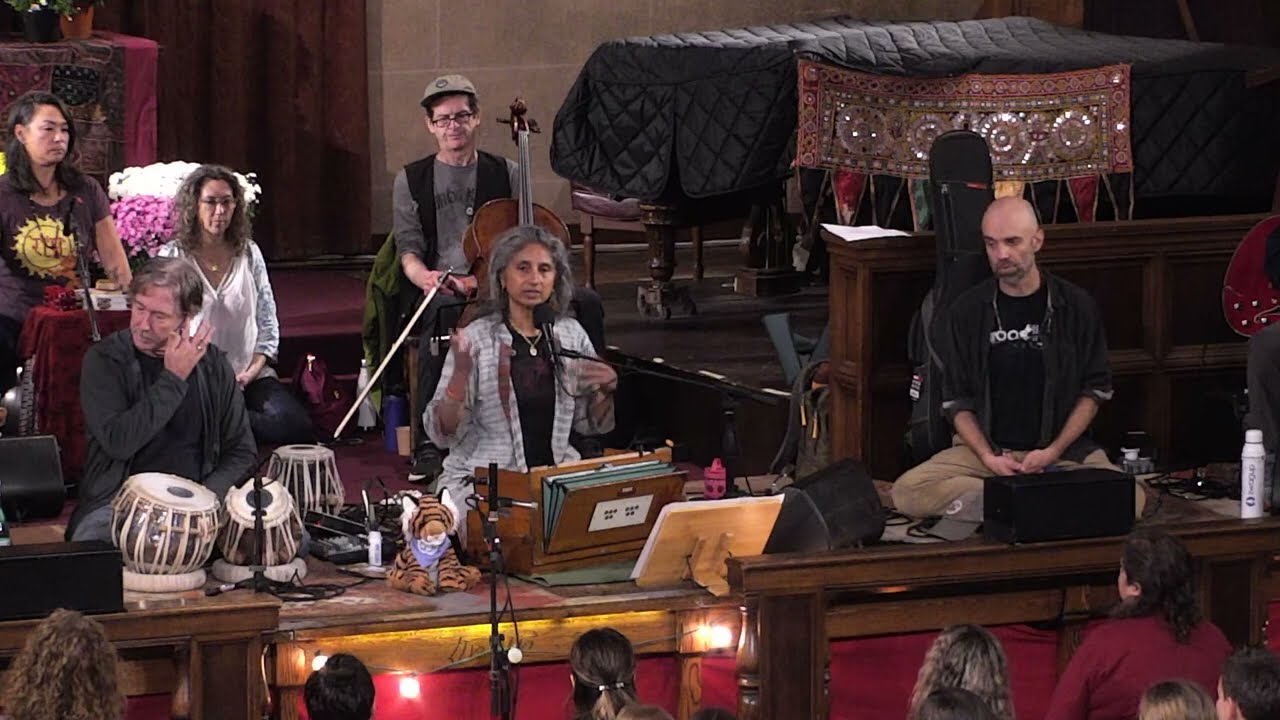
This performance documents Jai Uttal and the Queen of Hearts Orchestra at a CD release event and bhakti dance party held in San Francisco. The event captures contemporary devotional music in an urban concert setting, demonstrating how bhakti practice—rooted in chanting, music, and movement—operates outside traditional ashram contexts while maintaining spiritual intention.
What Is Bhakti Music and Why Does It Include Dance?
Bhakti refers to the yoga of devotion—a spiritual path emphasizing love and emotional surrender to the divine. Unlike meditation practices that emphasize inner stillness or philosophical inquiry, bhakti generates energy through sung mantra, rhythmic call-and-response chanting (kirtan), and full-body participation. Dance is not decoration in bhakti contexts; it is a direct expression of the heart's longing and a way to move devotion through the body rather than contain it in the mind.
Jai Uttal represents a lineage of Western bhakti musicians who received training in traditional Indian chanting and devotional practices, then adapted those forms for contemporary audiences. Rather than performing in formal concert dress, bhakti events like this one frame the performance as a "dance party"—signaling that participation, movement, and spontaneous expression are expected and welcomed.
How Does the Queen of Hearts Orchestra Blend Traditional and Modern Elements?
The use of the term "orchestra" signals a departure from the minimalist kirtan model of voice and hand drum. By arranging bhakti material for multiple instruments, Jai Uttal creates a fuller harmonic and rhythmic space while preserving the essential structure of call-and-response devotional chanting. An orchestral arrangement provides instrumental meditation points—moments when the human voice steps back and the listener can sink into instrumental sound.
The album title "Queen of Hearts" itself carries symbolic weight in bhakti tradition. The heart—not the intellect—is understood as the seat of direct spiritual experience. The "queen" metaphor suggests sovereignty, beauty, and the divine feminine principle (often associated with Shakti or the Mother aspect of God in Hindu and yogic philosophy). This poetic framing distinguishes the musical project as something beyond a straightforward presentation of traditional Sanskrit chants.
What Role Does the Live Concert Setting Play in Devotional Practice?
Yoshi's, a renowned jazz and world music venue in San Francisco, typically hosts secular performances. Holding a bhakti CD release and dance party in this venue represents a deliberate choice to bring devotional practice into urban, contemporary spaces accessible to general audiences—not only to committed spiritual seekers in retreat settings. This democratization of bhakti means that people encountering the practice may arrive without prior training, Sanskrit knowledge, or conscious commitment to spirituality, yet still participate in the energetic and emotional current of the music.
The "CD release" component indicates this is also a commercial and artistic venture. Jai Uttal is documenting and distributing his musical work, placing it in the marketplace of ideas and sound. This dual function—sacred practice and professional music—reflects the reality of contemporary bhakti artists who must sustain themselves while remaining true to spiritual intention.
How Do Kirtan and Orchestral Arrangements Support Collective Experience?
One fundamental principle of kirtan is that the call-and-response structure creates coherence among participants. The leader (Jai Uttal) sings a phrase; the group echoes or responds. This creates a shared breath, a synchronized heartbeat, and a sense of moving together toward something larger than individual minds. When orchestral instruments support this structure, they amplify the emotional resonance and create more sophisticated harmonic pathways for the energy to travel.
The dance component reinforces this collective intention. Bhakti dance is not choreographed performance art meant to be watched passively; it is an invitation to move the body in ways that express internal states—joy, surrender, longing, ecstasy. In a room of people moving together to the same rhythms and melodies, boundaries between self and other can dissolve. This is the functional magic of bhakti: it uses emotion, music, and physical movement to create temporary communities united by shared feeling.
What Does a Bhakti Dance Party Communicate About Spirituality Today?
The framing of this event as a "dance party" rather than a "concert" or "worship service" signals a cultural shift in how Western practitioners relate to devotional practice. A dance party suggests spontaneity, joy, embodiment, and freedom from rigid rules. It invites the entire self—body, emotion, mind—into the practice, rather than asking practitioners to transcend or escape the body.
This approach aligns with contemporary interest in somatic spirituality—the recognition that the body is not an obstacle to enlightenment but a primary instrument of spiritual knowledge and transformation. By anchoring bhakti practice in music, dance, and physical presence, Jai Uttal and similar teachers make devotion accessible to people who may feel alienated by purely intellectual or meditative approaches.
How Does Album Release Function as a Spiritual Act?
Recording and releasing an album of bhakti music is itself a form of dana (spiritual giving in Sanskrit). By making the music available to listeners who cannot attend live events, Jai Uttal extends the reach of the practice. Albums also create archive—a preserved record of how bhakti sounded in a specific time and place, available for future generations and distant listeners.
The CD release event combines three functions: it celebrates the completion of an artistic project, it creates an opportunity for live transmission (the direct energetic exchange possible only in person), and it marks a moment of community gathering. For practitioners of bhakti, each of these dimensions matters.
Where to go from here
If this exploration of bhakti music and devotional dance resonates, consider attending a live kirtan event in your area—whether led by trained teachers or in community settings. Listen to recordings of traditional Indian classical singers who specialize in devotional music (raag-based bhajans), and notice how the form differs from Western orchestral arrangements. If you are interested in the philosophy underlying bhakti practice, explore the Bhagavad Gita's discussion of bhakti yoga, or read contemporary teachers like Pema Chödrön or Krishna Das who bridge traditional wisdom and modern life.