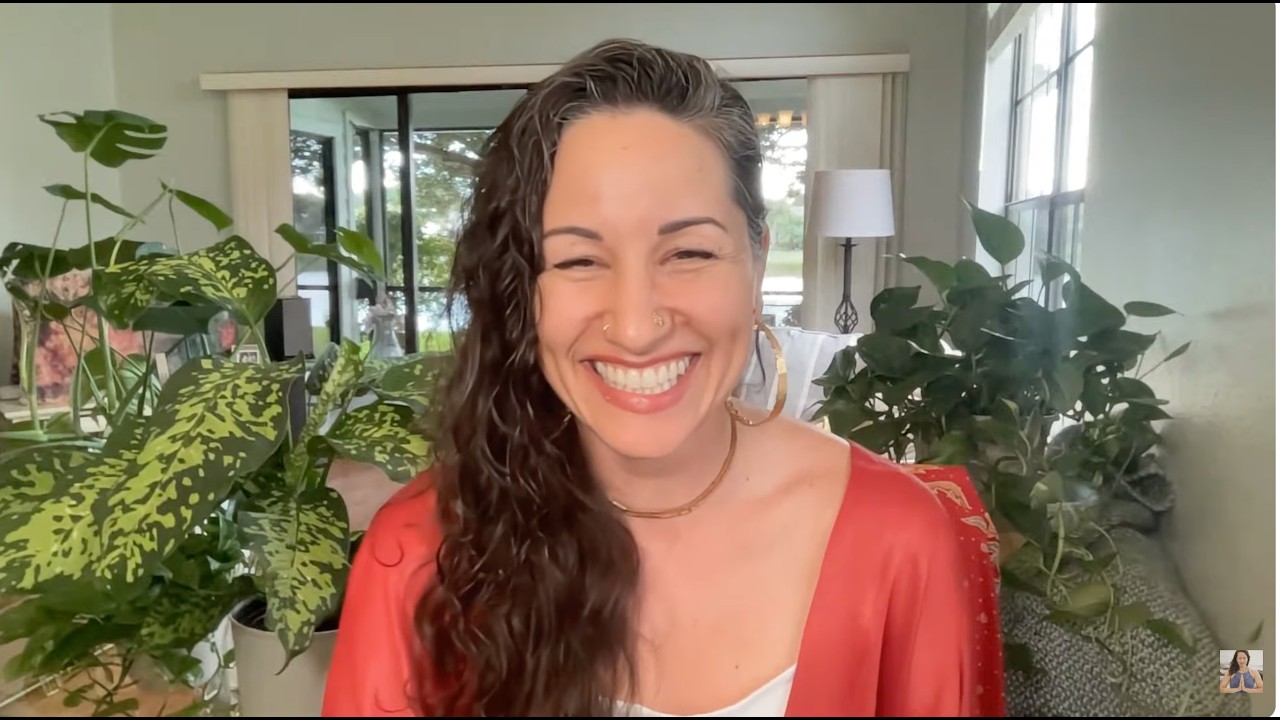
In this conversation, Byron Katie guides Tori, a caller from France, through The Work—a four-question self-inquiry method designed to reveal how suffering arises not from circumstances but from the stories we believe about them. Katie demonstrates that the burden of parenting too young is not the children themselves, but the thought "I'm too young to have children at my age." By questioning thoughts, identifying opposites, and experiencing life without mental narratives, we can step out of the dream of past and future into the grace of what is actually present.
What Is The Work and Why Does Katie Use It?
The Work is a simple but profound method of self-inquiry that Katie has taught for decades. It consists of four questions and a "turnaround" exercise designed to help people question the thoughts that create suffering. Rather than accepting negative thoughts as truth or trying to change our external circumstances, The Work invites us to examine the thoughts themselves. As Katie explains in this session, "The story you place on the images in your head costs you your life." The Work is not about positive thinking or forced acceptance—it is about discovering, through direct inquiry, whether our most painful beliefs are actually true.
In this conversation, Katie works with Tori, who initially came seeking help with self-judgment about parenting decisions made in the past. However, as the session unfolds, Katie guides Tori to a more immediate situation: a moment when Tori was sitting alone in her studio, overwhelmed by the thought "I'm too young to have children at my age." This specific, localized situation becomes the ground for Katie's teaching, showing that The Work requires us to anchor our inquiry in a concrete moment and place, not abstract generalizations.
Why Getting Located Matters in Self-Inquiry
One of Katie's first moves is to get Tori to locate herself precisely in time and space. She asks: Where are you? Are you sitting or standing? What room? Is there a window? This might seem like a tangent, but it is fundamental to how The Work functions. Katie says, "You see how important it is that you get located? When you're doing this work, you get located." The reason is that suffering is not abstract—it is embodied, situated, and specific. When we locate ourselves, we ground the inquiry in a real moment where a real thought was believed, rather than floating in generalizations about our lives.
For Tori, this becomes the moment she sat alone in her studio in France, feeling the weight of early motherhood. By seeing that moment clearly—seeing the chair that supported her, the walls, the objects around her—Katie invites Tori to notice what was actually present: not the crushing burden she felt, but a room, a chair, silence. This distinction between what is literally there and what the mind adds to it through story is central to Katie's teaching.
The Difference Between Children and the Thought About Children
When Tori experiences the thought "I'm too young to have children at my age" while sitting in that studio, she reports feeling overwhelmed, sad, depressed, cheated, and burdened. Katie then asks Tori to notice: is it the children who are a burden, or what she is believing about the children?
This is a crucial pivot. Tori's children were not in the room. She was sitting alone. The child did not need her in that moment. What was present was only her thoughts, images, and stories about what it meant to be young and responsible. When Tori examines this directly, she realizes: "It's absolutely what I'm believing." The burden was never the children themselves. The burden was the mental narrative layered over the situation.
Katie illustrates this by asking Tori to notice the difference between sitting in that chair with the thought and sitting in that chair without the thought. Without the story, Tori would simply be present, perhaps available, at peace. With the story, everything feels impossible. This simple exercise reveals the machinery of suffering: we add a layer of narrative to reality, believe it, and then experience the emotional consequences of that belief.
How Acceptance Becomes a Story We Believe
Tori's second statement, drawn from her own reflection, was "I want to accept what's going on." On the surface, this sounds wise and mature. Who wouldn't want to accept reality? But Katie questions whether this is actually true. She asks, "Is it true that you want to accept what's going on? Or do you want to argue with reality?"
Here Katie makes a subtle but important distinction. She says, "What's going on is going on, whether you accept it or not." Reality does not require our acceptance; it simply is. When we say "I want to accept what's going on," we are implying that acceptance is a future achievement, something we need to work toward. But this very thought—"I want to accept"—contains within it a rejection of what is, right now.
Katie explains: "Other than what you're thinking and believing, there's nothing to accept. There's just the grace of reality." She is not saying that we should be passive or resigned. She is saying that in that moment in the studio, the actual situation was: a chair supporting Tori, a room, walls, perhaps light. There was nothing inherently unacceptable about any of that. The feeling of unacceptability came entirely from the story.
When Katie asks whether the thought is true, Tori begins to see the comedy in it. Eventually, Katie notes, people "laugh at these things: I want to accept what's going on. It's hilarious, no I don't." The resistance is already built into the thought itself. The thought is a form of argument with reality disguised as acceptance.
What Happens When We Believe the Thought?
The third question Katie explores is the emotional and behavioral consequence: "How do you react when you believe this thought?" When Tori believes "I want to accept what's going on" while actually not accepting it, she reports feeling incapable. This incapacity is not the result of being young or inexperienced; it is the result of being lost in an internal movie.
Katie says, "You're sitting there, lost in the dream. You're believing everything you think about those images. You see images of past and future, so you're sitting there, lost in the dream." The mind generates mental images: memories of what she should have done, projections of how her children will suffer because she was too young, fantasies of an alternate life where she waited. These images have a movie-like quality, and we watch them as if they are real, as if they are happening now.
But in the actual moment—sitting in the studio—none of those images are present. Only the images are. The children are not crying. No one is asking anything of her. Yet because she believes the images, because she treats the movie as real, she experiences the emotional state that would be appropriate if the movie were real. This is incapacity rooted in illusion.
Who Would You Be Without the Thought?
The fourth question is perhaps the most powerful: "Who would you be without the thought?" This is not asking who you should be or who you want to be. It is asking: in the absence of this particular story, what is your actual state in this moment?
When Katie poses this to Tori, she recognizes that without the thought, she would be present, available, at peace with her situation. She would be what is actually going on: the chair, the room, the breath, the moment. This is not a philosophical abstraction. It is a direct experience that becomes available once the story is temporarily set aside.
Katie deepens this teaching: "The mind is like a child that hasn't found its way home yet. It doesn't know how to be or rest in itself. It doesn't know how to question itself, so there's chaos. And the feelings that come with that can be terrifying." The mind generates endless stories because it does not know how to be still. But underneath the mental activity, there is a capacity to simply be present, to notice, to rest. The Work is a way of training the mind to question itself, to find its way home.
Finding the Opposite: Turnarounds
After examining a thought, Katie guides people to find its opposite. For "I'm too young to have children at my age," the opposite is "I'm not too young to have children at my age." This is not meant to be a false affirmation. Rather, it is an invitation to notice whether the opposite might also be true. For instance, in that moment in the studio, Tori's child did not need her. She was not too young or too old; she was exactly what was needed, or more precisely, her age was entirely irrelevant to what was actually happening.
The turnaround for "I want to accept what's going on" might be "I don't want to accept what's going on," or more profoundly, "I want to argue with what's going on." When Tori explores this, she discovers that the turnaround has truth as well. Part of her has been resisting, arguing, refusing. This is not a problem to fix; it is a pattern to notice. Sometimes we want to accept, and sometimes we don't. Both are human. The problem arises only when we tell ourselves a story that one of these states is wrong.
The Nature of Reality and the End of Fear
Katie offers a teaching that may sound radical: "You can trust reality. It's not going to shift or move for you. Once you know the nature of the universe, that it's kind, giving, and one hundred percent for you, in service to you—once you understand that, there's no fear of just noticing what's going on." This is not naive optimism. Rather, it is a recognition that reality, as it is, does not oppose us. Our circumstances may be difficult, but the universe itself is not hostile.
This teaching emerges from the direct experience of The Work. When Tori examines her actual situation—not her thoughts about her situation, but the situation itself—she finds no enemy. She finds a chair, a room, her own presence. The "enemy" is only in the story. Once she sees this, there is nothing to fear in reality itself. The fear belongs to the movie, not to what is.
Where to Go from Here
Katie's invitation at the end of the session is concrete: "I invite you to complete a Judge-Your-Neighbor Worksheet, question your thoughts, and wake yourself from the dream." The Judge-Your-Neighbor Worksheet is the foundational tool of The Work. In it, you write down a situation where you were upset, identify the thought you were believing, and then put that thought through the four questions: Is it true? Can you absolutely know that it's true? How do you react when you believe it? Who would you be without it?
The goal is not to reach any particular conclusion. The goal is to develop the habit of inquiry, to train the mind to question itself rather than automatically believe every thought that arises. As Katie says, "The mind doesn't know how to question itself," but it can learn. Through repeated questioning, the mind begins to loosen its grip on stories, and we begin to live more directly from what is actually present, rather than from the dream of what we think should be happening.
This shift—from arguing with reality to noticing what is—is available to us in this moment, and in this one, and in this one. The Work is an invitation to step out of the dream and into the only life that is actually lived: the one happening now.